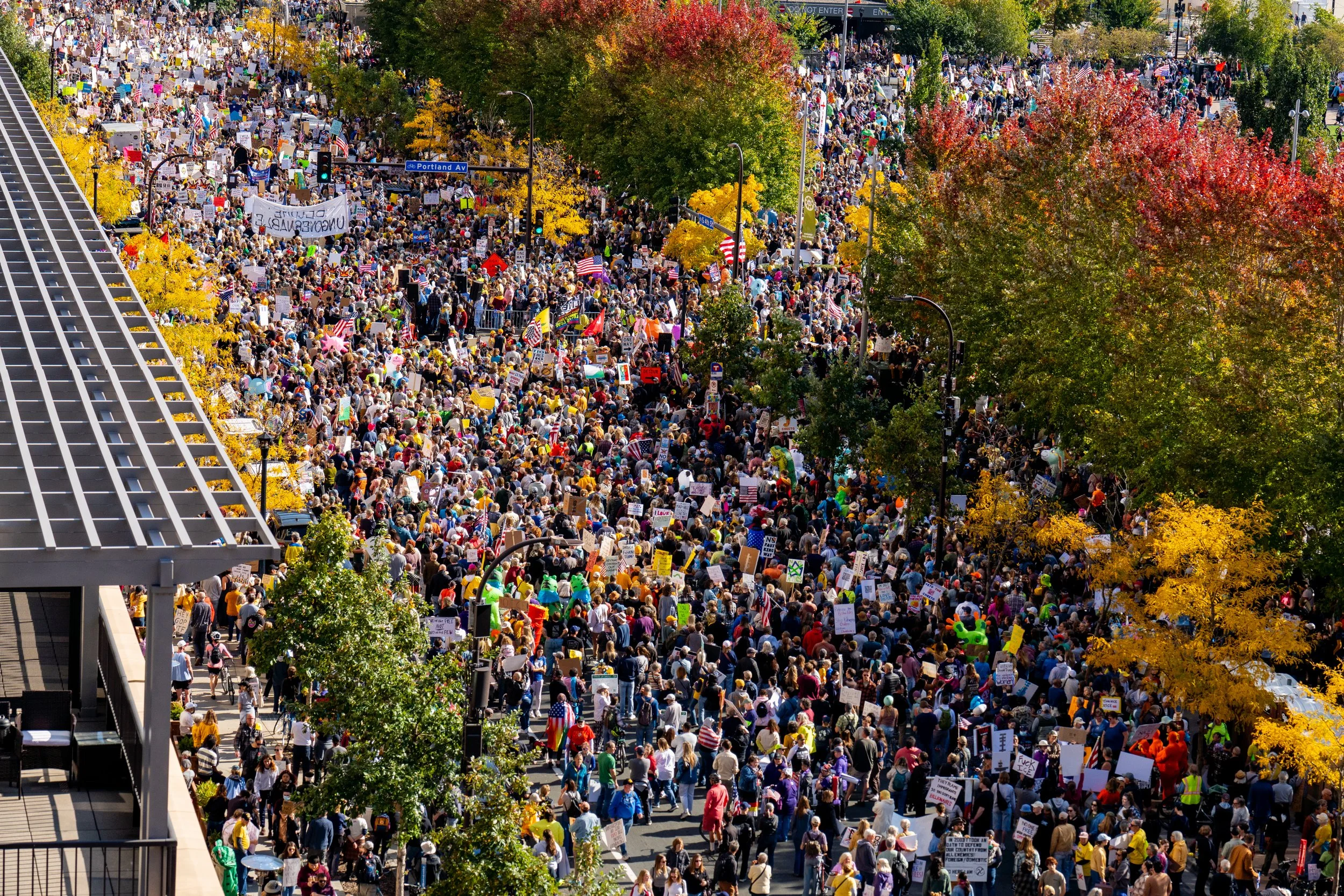
At the beginning of the lesson, Matthew describes a crowd that was following Jesus after he had performed acts of healing of diseases and sicknesses of the body, of the mind, and of the soul. Matthew says that Jesus saw the crowd.
Everything Jesus did was intentional. And nothing Jesus did was reactionary.
Jesus needed to model to his disciples that in a political and economic environment, when the federal government in Rome was intentionally keeping the target moving on the righteous thing, on the peace thing, and on the solidarity thing, their response must be intentional, and not reactionary.
The Church today is called to just that. To be intentional and not reactionary.
Being reactionary is playing right into the strategy of Donald Trump and the Trumpian Conservative and White Nationalist government in Washington. What they want is to keep us reacting and not to be intentional. Those who hold up the flag of a blue-eyed, blond, Nativist, and exclusionary Christian cult want us to be reacting because reacting means we are scattered in our response, disorganized in our ability to sustain solidarity, and unfocused in our impact.
This is all by design. And it will continue to play to the hand of those who want a white, cultish, man-focused, heteronormative, and violently submitted nation, and a world subservient to their whims and dreams.
Jesus, a colonial subject of the Roman Empire - an empire whose national name was the Roman Republic - knew this of Romans in the 1st century.
Rome and the United States are not identical, but empires share recurring strategies.
Followers of Jesus, and every person of goodwill in the 21st century, should know this by now about the leaders of the United States: a nation said to be constituted as a republic that has for decades been, at best, an oligarchy with 250 years of ethnocentrism, and what seems to be a very intentional move into autocracy.
The right wing wants progressives to see the crowds and throw themselves into acts of healing, and to keep those acts going unsustained, without end in sight, to the point of being spent and burned out.
The Roman Empire and its Jerusalem lackeys looked for the same reaction from the likes of John and Jesus. Until John got too close to the truth and power, calling Herod the corrupt, morally bankrupt man that he was - an embarrassment to all the Jews, and now a potential liability for the Roman authority. That is why he was arrested and executed.
Jesus knew this was what the Romans wanted. And after being present, showing compassion and solidarity, and participating in the power of being in and among the community, he saw the crowd…
…went up to the mountain. And sat down.
And as much as I know this may sound counter to how many of you think of the responsibility and possibilities of this congregation, especially up against the onslaught from the Empire, I will say it again - Having done acts of compassion, presence, solidarity, feeding, hospitality, peace and love, when we see the crowds, the multitude of people who in our witness of Jesus see a bright glimmer of another way of being community, the call is not to go rushing back as if we had endless political, social, human and financial resources. The call is to see, to go up, and to sit down.
Jesus not only saw the crowds. The term in the original language suggests that the action was to behold, to perceive, to discern. Seeing, beholding, perceiving, and discernment cannot be done in the constant and incessant doing. One needs to step back. One needs to consider not merely the sheer number, but to understand that back then and today, the numbers are overwhelming. The call is to consider what the numbers are saying, what they are requiring, and what our capacity is to go at them with solidarity and sustainability in each hand, each foot, and each voice.
One also needs to realize that while an individual might be passionate about one or a few things and think they can single-handedly keep that passion going, not one person will be able to achieve change. And I will suggest that even Jesus, the human and divine One, knew this, that not even he could do everything and be everything for everyone, especially up against an Empire that was successful in its capacity to demean and disenfranchise.
Jesus saw the crowd, went up to the mountain, and sat down. His disciples clearly noticed what he did, and I imagine that some of them might have been surprised.
The impact, influence, and faith of the Presbyterian United Church of Christ, of followers of the Jesus from Bethlehem, Egypt, Nazareth, and Galilee, and of people of good will not be measured by how much any one of us keet doing, but by our ability to see the crowds, to learn from the crowds, not to be reactionary, and to be intentional in our presence and in allowing that presence - praying, working, and learning - to change our hearts, our minds, and our spirits to the movements of community in the margins.
Jesus sat down on the mountain with his disciples and taught them. He did not teach them how to be 1980s or 1990s American liberal leaders and to follow him unconditionally. Jesus taught them about how the crowd of people disenfranchised by the Roman Empire were able to live life in hope, community, and solidarity despite the Empire. And that in holding to life, hope, community, and solidarity, they, the crowds, found blessedness.
Jesus taught his disciples not simply to see, but to discern the crowds. And Jesus also taught them that true, sustainable, and sustaining acts of hope and goodness are not acts of a lot of individuals. The disciples might have seen an overwhelming number of individuals. Many of us are overwhelmed by the sheer number of individuals persecuted, prosecuted, demeaned, and disenfranchised by the state. Jesus sees a crowd.
Plurals and collectives are not the same. “Persons” and “crowd” might both speak to a plural number of individuals; a crowd is the collective of persons with something in common. While I will be the first one to critic having committees for the sake of having them, I will also be the first one to say that a hallmark of Presbyterianism and Congregationalism is not the governing and doing of a lot of ones, but the coming together, as a collective, to see, discern, plan, do, review, and to sustain.
“Plurals and collectives are not the same… a hallmark of Presbyterianism and Congregationalism is not the governing by and doing of a lot of ones, but the coming together, as a collective, to see, discern, plan, do, review, and to sustain.”
In teaching his observations and perspective to his disciples, Jesus also invites the disciples to know, to understand, to internalize, and to practice that the reach of the gospel, the work of goodness, and the impact of grace is not the work of many followers, but of one community of the faithful.
Let us remember that we are not called to be a plural of individuals with individual opinions and side projects. We are called and expected to be a collective - an intentional collective, a learning collective, a discerning collective, a committed collective, a collective that knows how it will sustain itself and the generation after, a collective that acts in solidarity, a church, a community of faith.
This is what Jesus teaches and lives out throughout his ministry:
Plurals are not sustainable. Collectives are resilient.
Amen.
part of a sermon shared with the Presbyterian United Church of Christ (Saratoga Springs) on Sunday, February 1, 2026