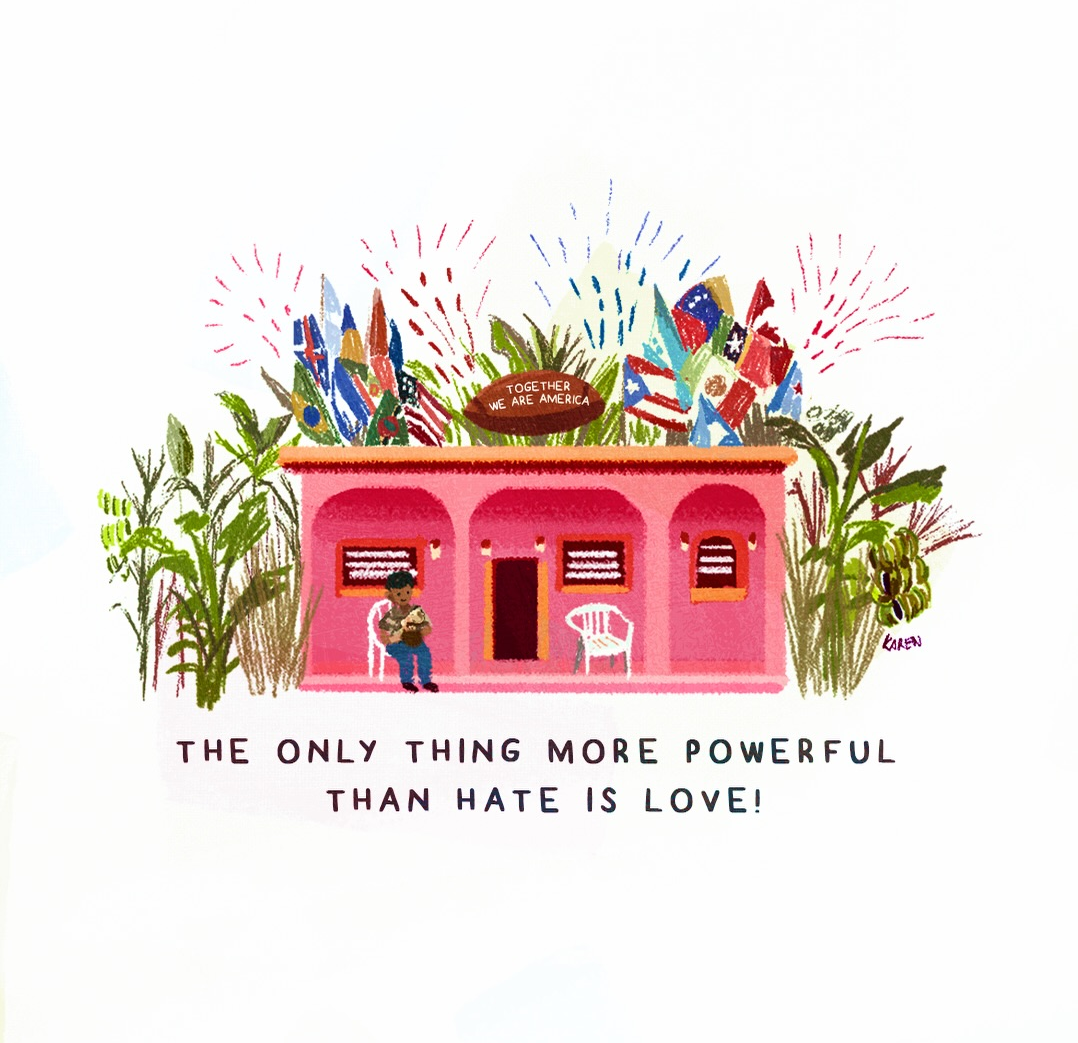
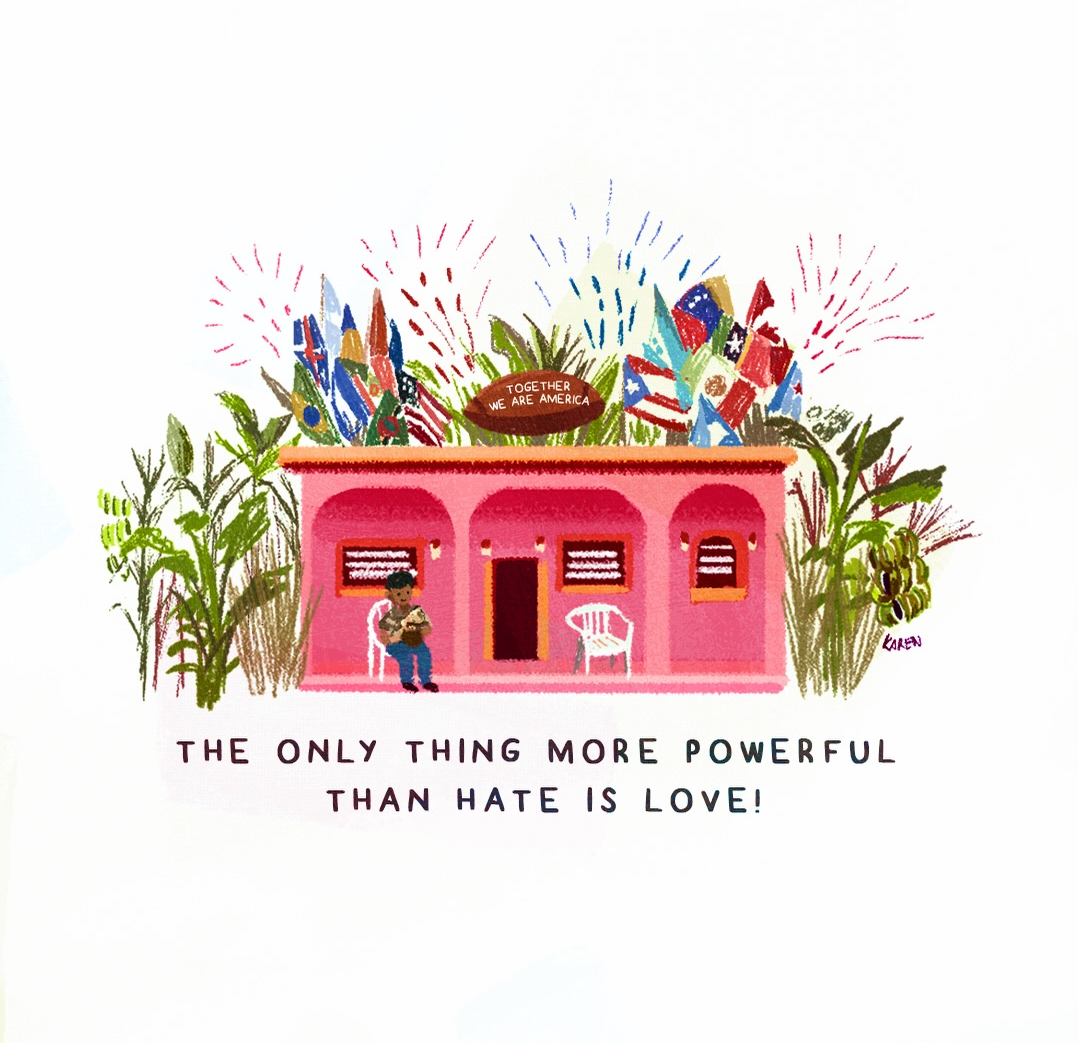
image by Karen González Ibarra @karengonzalez_art
Benito Antonio Martínez Ocasio has been giving faith leaders and politicians in Puerto Rico and the United States much to talk about for quite some time now. For those of us active on social media, the posting and commentary about Sunday’s Super Bowl halftime show have been ubiquitous (not a complaint. I’m here for all of it!). Many elements of the show Benito and his crew offered to millions across the continent and around the world are worthy of reflection. One of the most salient for me is that Martínez Ocasio’s presentation was not simply a cultural display.
While rooted in elements that are quintessentially Puerto Rican, Benito and his collaborators constructed a historical narrative through images, music, movement, and words. It connected the history of Puerto Ricans to the broader history of the peoples of the American continent and beyond. For thirteen minutes, he made the continent feel like home for everyone. In doing so, he challenged the nativist, White Supremacist (and I would add, Trumpian) impulses present in U.S. sociopolitical life. And he did so on one of the nation’s most visible cultural stages. All the while, he unapologetically highlighted Puerto Rico’s national identity.
The negative reactions to Benito’s performance were not only sociopolitical; they were also religious. Christian conservatives and fundamentalists in both the United States and Puerto Rico have been clutching their proverbial pearls over his style and lyrics. While I am not entirely sure why the moral outrage feels so intense - after all, within his chosen musical genre, Benito has long presented himself as an urban and trap performer - it seems evident to me that what is being revealed is a preference for narratives of morality over community, outrage over joy, and judgment over solidarity.
In an op-ed responding to similar criticism during Benito’s performances in Puerto Rico this past summer, a colleague wrote:
“Before the biblical witness of collective happiness produced by the message of Jesus, I ask myself: What is going on with Christians that we are not infecting the city with happiness? Instead of healing and affirming, we lead debates that seem to make enemies even among ourselves. To criticize Bad Bunny by saying that the devil took over the island has not brought us happiness. For Benito is not the problem… the problem is corruption and violence.
What Benito has accomplished should confront us: What are we doing so people feel seen and supported, and happiness. return to our city? For it is when people feel seen in their dignity that authentic transformation — and the return of happiness — can begin.”*
I am grateful - and also appropriately challenged - to have no concern about the capacity of the members and friends of the Presbyterian United Church of Christ to be people committed to seeing others for who they are, affirming and protecting dignity, and embodying community and solidarity. We cannot ignore, however, that many self-identified Christians attempted to boycott his show last Sunday, ostensibly because of his lyrics and performance style, while simultaneously supporting an alternative presentation that, draped in a cross and the U.S. flag, stood against the e pluribus unum ethos of this country and instead echoed White nationalist hopes for the nation.
A conservative pastor reflected on social media:
“What I found myself seeing, uncomfortably, was this:
One show declared the source of the gospel without fully embodying its effect. The other reflected the effect of the gospel without naming its source.
The gospel isn’t just Jesus named.
And it isn’t just love expressed.
It isn’t just heaven in the afterlife.
It is heaven on earth now.
It is Jesus enthroned as King, forming a people who embody his love across real differences, without retreating into fear or dissolving into abstraction.”^
He describes a tension between naming the source of the Gospel (Jesus) and embodying its effect (love) in two very different performances. It may not surprise you that I do not see such a tension. To me, the “alternative” show was not a conservative religious response so much as the use of Christianity as a vehicle for White nationalism and nativism. Benito’s performance, for its part, had no intention of being a religious statement. It was art - performance, history, culture, diversity, memory, shared identity, and shared difference, solidarity.
The only thing more powerful than hate is love. Some may be trying to reconcile categories that do not need reconciling. I will not hold Benito to the theological, confessional, or disciplinary standards of an ordained minister.
What I was glad to see is that his presentation consistently communicated that love is more powerful. And I was equally glad that the following evening, some fifty Saratogians gathered to sing in solidarity with Minneapolitans. Some may have participated as a witness of how they follow the teachings of Jesus. All participated because they believe that peace, solidarity, community, and love will carry us through dark times.
Whether prompted by a groundbreaking show by Benito or a song written by Bruce sung by Saratogians in solidarity with Minneapolitans, naming Jesus is not what will change the world. It is living with Jesus, and with every person of good, the commitment and imperatives of dignity, solidarity, community, and love. In that, I see no tension.
*The Rev. Dr. Ivelisse Valentín Vera, "El Problema de Puerto Rico no es Benito", El Nuevo Día, 5 August 2025. Dr. Valentín Vera is a minister in the Church of the Nazarene, and a professor of communications and popular culture
^The Rev. Brian Drinkwine in his Facebook page, 9 February 2026. Rev. Drinkwine is a non-denominational pastor