“Then Miriam the prophet,
Aaron’s sister,
picked up a hand-drum, and all the women went out after her in dance with hand-drums.
And Miriam chanted for them:
Sing to GOD,
who has triumphed gloriously;
Horse and driver have been hurled
into the sea.”
March is Women’s History Month.
Women have been and continue to be central to the life, ministry, presence, sustainability, and fellowship of the church. This is most certainly true for our congregation. By the numbers:
Just under 70% of our Governing Board, Trustees, and Deacons are women.
All but one active Elder, and all but one active Deacon, are women
Each one of our board committees is chaired by women
Most of our Faith in Action initiatives or partnerships are led by women
If my calculations are right, this congregation has been served by 5 women and femme pastors in its recent history, one of whom is my predecessor as pastor and head of staff.
The presence of women in my rearing and vocational discernment was ubiquitous. I had the opportunity to have had a relationship with a great-grandmother, my two grandmothers, and a godmother. The values and commitments of these women were about family, their community, and their faith.
Sebastián and Aiden are being raised by a woman with similar and deeply held commitments, and I get to be challenged and share those commitments with her. And while I often lament that Sebastián might not have the same relationship Jeannette and I had with our grandmothers, he does have passionate grands, and aunts - both by blood and by relationship - who will show him what strong committed women look and are like.
I can go on about experiencing the leadership of women as associate pastors in the congregation I grew up in, and as Executive Ministers of the Baptist denomination my church was a part of. I can talk about the leadership and commitment of women and femmes I have had the privilege to work with in community organizing, social resilience, advocacy, and solidarity.
I also acknowledge that this has not been the experience of many. As strange as this might sound, it’s only been 106 years since white women were allowed to vote in the United States. Roe v. Wade, the Supreme Court decision that gave women the right to choose over their bodies, only had a 49-year run, as it was overturned in 2022.
As we begin the 2nd quarter of the 21st century of the common era, women throughout the world continue to face significant challenges to their health, safety, and agency. Globally its gender violence, limited access to educational opportunities, economic inequality, and health disparities - especially for mothers, among others. In the United States its reproductive health access, the gender-pay gap, and the burden of caregiving, among others.
And, of course, when considering intersectionalities - the expression within racialized and ethnic groups, queer identities, and the pervasiveness of poverty, everything just gets more complicated.
I think we can all agree that the sociopolitical situation of women in the historical periods represented in our Holy Scriptures was also challenging.
And here we are, in the 21st century and the United States, still talking about the status of women in politics, society, and even religion and faith:
115 years after the establishment of International Women’s Day,
54 years after the approval of the amendment of Title VII and the addition of Title IX of the Civil Rights Act, providing equal access and non-discrimination policies in education and the workplace to women, among other minoritized groups, and
54 years after the approval of the Equal Rights Amendment to the US Constitution, which arguably failed to be ratified
And while many of us would want to kid ourselves and think that we can compartmentalize the conversation about the status of women as a separate, even manageable issue in contemporary social and political discourse, women and femmes, womanhood, is, yet, another intersection in the history of sinful and consuming history of chauvinism, racism, impoverishment, and nationalism of which the United States is guilty of.
And yet, women have been and continue to be central to the life, sustainability, and fellowship of the church and of community. Something I think we can all agree to be true today and throughout history.
When the children of Jacob were set free from slavery and bondage in Egypt, they were all told to pack for travel - unleavened bread, clothing, and jewelry given by the Egyptians, livestock, and the bones of Joseph, the son of Jacob. You can find the packing list in the narrative of the Exodus in chapters 12 and 13. They moved fast. After the last plague, Egyptians all but had it, and all but expelled them.
They traveled according to the direction God was giving Moses, and eventually found themselves by the Red Sea. What no one in the story counted on was that Pharaoh would recant his order to expel the Hebrews. After all, according to the biblical narrative, we are talking of 600,000 men, not counting children, who were enslaved. In purely capitalist financial analysis, the replacement of disenfranchised and enslaved labor of this magnitude was not only not cost-effective. It was impossible.
People are scared. Moses prays. The people complain. God tells Moses to cross the sea. The sea opens up to dry land. This amazing number of people cross over. They reach the other side.
Moses starts to sing, and I would argue that the men with him, what I think is more of a prayer. I don’t know if it’s a prayer of gratitude or of faith increased by God’s action. They had seen the forces of Pharaoh drowned in the sea as the walls of water collapsed over them, when moments before they were complaining to Moses for having taken them into the wilderness in obedience to God’s guidance.
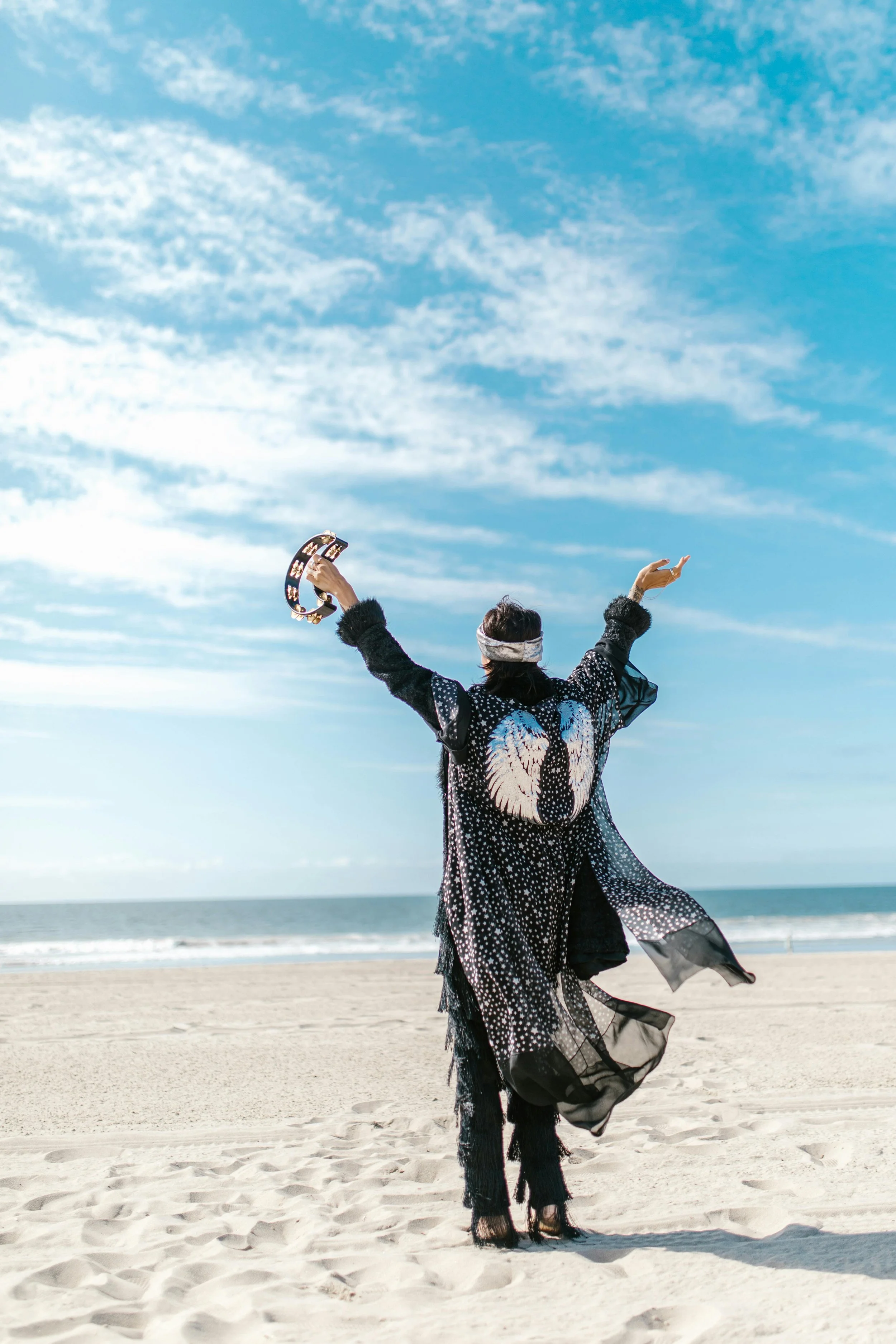
Photo by RDNE Stock project
And then Miriam,
called a prophet,
the sister of Aaron, the high priest,
and of Moses, the guide to deliverance,
picked up a hand drum.
I mentioned earlier that a few chapters earlier in the Book of Exodus, as they were leaving Egypt in haste, they only packed unleavened bread and dough, clothing, gold and silver given to them by the Egyptians, livestock, and the physical memory of their ancestor.
Where did these hand drums come from that Miriam and every woman had?
In one of the defining moments of the relationship between God and the children of Jacob, in a moment when every method of logic defies any expectation that a good outcome is possible, much like the way I think Moses and the male leaders of the people did, one focuses on packing light, getting yourself out of the situation. And even when indeed the outcome exceeded every measurement and expectation, what most of us can muster is a prayer where, at once, our sense of doubt and wonder is expressed, as in expressing a little sense of disbelief and relief about what has evidently taken place.
In one of the defining moments of the relationship between God and the children of Jacob, in a moment when every method of logic defies any expectation that a good outcome is possible, what Miriam and all the women did, is to walk strong in the confidence that no matter what the models suggest, no matter how difficult the circumstances, no matter how social and political structure still work to undermine, demean, and ignore the perspective, presence, and power of women in social and community leadership…
…no matter the order to pack light,
they packed hand drums and tambourines,
because they knew before any of the men could even imagine it,
that God is faithful to the promise of freedom and peace.
Before they even began to walk out of the land of Egypt into freedom and peoplehood, before they found themselves at the shore of the Red Sea, before they crossed the sea on dry land…
…before they had been set free,
the women knew that God would keep the promise of liberation,
and they were ready, despite the order of men to pack light,
with the accoutrements needed to encourage and live into their particular capacity
to live a life of presence, sustainability, and fellowship.
They knew before it all happened that they would have reason to sing and dance.
Moses led a song of victory for what had happened, a song to mark an event after the fact.
Before it happened, Miriam and the women packed hand drums in preparation and in certainty of liberation. Lent calls the faithful to the forethought of hope, to the certainty of freedom and deliverance, even when every logical paradigm points to doom and evil.
And what women continue to embody in the struggle for solidarity, community, and peace is the capacity of humans to bring hope along as history takes place. The hope of the followers of the God of Jesus and the God of Jacob is not a hope because of what has taken place, but a hope that launches us from an uncertain present into a hope and peaceful future.
And for that lesson, we have Miriam and women throughout time and space to thank.