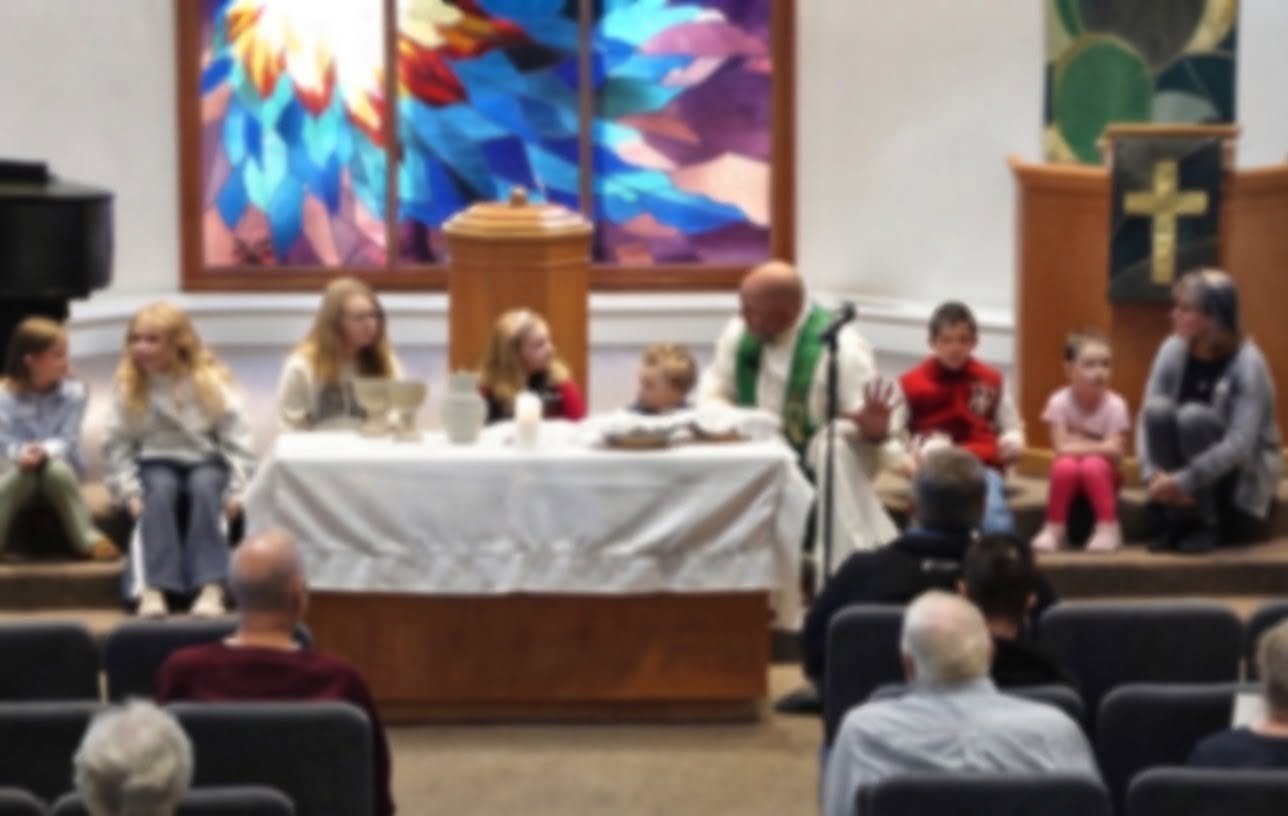
A sermon shared with the Presbyterian United Church of Christ on 10/11/2026
based on Philippians 4.4-8
Imagine being in that church, on that Sunday.
A house, perhaps Lydia's. Perhaps Lydia’s living room. A room of merchants and enslaved people, retired soldiers and widows, and a jailer with his whole household - yes, that jailer who kept Paul and Silas in prison.
Philippi was a Roman colony, a city built in the image of Rome and expected to obey Rome without question. The political, economic, and social fabric of the empire seemed to be unraveling. A change, any change of policy would come down from the imperial capital, and local governors would implement it, each for their own benefit, and seemingly with their own appetite for cruelty. Every time people figured out how to stay afloat, the rules changed. What was sown was uncertainty. What was reaped was pain, suffering, and, too often, terror.
And Paul was writing from prison, facing charges of sedition. Paul and the community in Philippi reading his letter knew that on the other end of his imprisonment was execution.
So the letter is read. And I can only imagine that near the end, the reader slows down:
Rejoice in the Lord always; again I will say, Rejoice.
Period? Exclamation point? Question mark?
Rejoice? Always? From a prison cell? With the empire tightening its grip on our neighbors, our livelihoods, our children?
And what is more, the tone does not sound like this is a suggestion. Paul is all but giving a command.
Rejoice in the Lord. Always. And again, I say, Rejoice!
I want to suggest that Paul’s command seemed to that community in first-century Philippi and may seem to some of us today as somewhat cruel, perhaps even masochistic. This is because some may think joy and happiness are synonyms, which would reduce them to mere feelings.
Joy is a gift. In Galatians, Paul names joy as part of the fruit of the Spirit: love, joy, peace. Of the 9 words that describe the fruit of the Spirit, joy is second, and is the only one that shares a root with the word charis - the Greek word which we translate as grace. Joy is a gift, a charism, that takes root, grows, bears fruit, and is able to be planted in the hearts, minds, and souls of people who need, who yearn for the grace of God in their lives.

photo by Mehin Qehreman
Happiness, alegría, is the delight of the moment, the laughter at the table over coffee or a meal. But then there is joy, gozo. Gozo precedes alegría and will remain when the party is over, the table has gone quiet, cleaning needs to happen, and things seem to be getting back to normalcy. For many, normalcy is not a happy place. For many, normalcy is barely getting through; it’s surviving. But for everyone, there can be joy - a reality of mind, body, and soul that keeps us seeking moments of happiness while keeping a deep certainty of fully being and of living abundantly. Paul knew this reality, this certainty, even in prison. Paul reminded the church of Philippi and reminds the church in Saratoga Springs that happiness feels good, but that joy is with us, with the whole community, always!
Philippians would never find joy in Rome. We will never find joy in Albany or in Washington. We will not find joy in circumstances, for joy is despite whatever situation you, we, the nation, or the world is facing and will face. Joy is a gift of the Divine, not a feeling. Joy is something we receive. Joy is something we need to practice. Joy is something we do. And what is more, joy is something we can give!
We are not the first to hear this command in a hard time. Our ancestors in the faith heard it too, in Reformation Germany and Scotland, under a fascist state, and here in the United States. In the confessions of our ancestors we read the witness of people who knew the cost of discipleship and insisted there is joy to be had, and joy to be done:
The Scots Confession, in 1560, tells the whole story of salvation as a story of joy. After humanity's departure from God, God came looking for Adam again and made him a most joyful promise. That promise was received with joy from Adam to Noah, from Noah to Abraham, from Abraham to David, until the faithful did see the joyful day of Christ Jesus, and did rejoice (Book of Confessions, 3.04). Joy is our inheritance, handed down through floods, exile, and empires.
The Heidelberg Catechism, which the UCC and the PC(USA) both claim, asks a question, the second question, which reflects both the struggle and certainty of life abundant:
What must you know to live and die in the joy of (knowing you are God’s own)?
The three-part answer:
that my sin and misery are great,
that I have been set free from all this sin and misery,
and that I get a chance to give thanks to God, not simply for setting me free, but for delivering me (Book of Confessions, 4.002),
that is, for God moving me, and moving you, from everything that pointed to death into everything that points perpetually to life!
And in 1934, as Hitler consolidated his power and the German state church bent its knee to the Reich, Christians gathered at Barmen and confessed:
As Jesus Christ is God's assurance of the forgiveness of all our sins, so in the same way and with the same seriousness is (Jesus) also God's mighty claim upon our whole life. Through (Jesus) befalls us a joyful deliverance from the godless fetters of this world for a free, grateful service to God’s creatures. (Book of Confessions, 8.14)
They wrote of joyful deliverance while fetters were being forged.
And in the Statement of Faith written by a recently formed United Church of Christ, it tells us the church is called into discipleship, taking on its cost and embracing its joy. Cost and joy.
Circumstances may be different now from those of the first century, but they seem to be much the same. We can talk about state-sponsored disenfranchisement and terror by the governments in Moscow, Managua, Tel Aviv, and Tehran. We can talk about despair taking hold of populations in Sudan, Cuba, France, Brazil, Iraq, Afghanistan, and Ukraine. But we do not have to go far, not in time, not in space, to talk about a state terrorizing its own residents. A state seems to intentionally break the spirit of a community, and even the sense of play and trust of children.
If we want to have the moral authority to talk about what is happening around the world, we must also be willing to change the course this country is on. And that course is being set by the policies of the monster in the White House, leading the American Empire into a greater abyss of hatred and division, inflicting suffering, pain, uncertainty, and despair on millions.
And there is this collective sense that there is nothing left to do, that come November it doesn't matter what happens. That capitalism, the supremacy of the personhood of corporations over the citizenship of individuals, and White Nationalism serving the god of Constantine are winning. That evil has the upper hand.
And the most recent evidence of this happened this week. On Thursday, Oscar Belgal was shot by agents of the state. In his car. With his five-year-old child in the back seat. In the Bronx, one of the most densely populated neighborhoods in this state.
What else is there to feel, if not despair? Or worse, powerlessness?
And what concerns me the most: what follows despair and powerlessness has been and continues to be apathy.
Despair says, it's too much.
Powerlessness says, there's nothing I can do.
Apathy says, I won't do a thing.
The government in Washington is guilty of terrorizing the nation. Yes. But many people in this country, and in this town, are guilty of apathy. An empire does not need everyone to agree with its policies. An empire does need enough people to stop caring.
To that apathy, our tradition has an answer. And it is the very first answer it gives.
In the 1640s, Presbyterians and Congregationalists gathered at the Westminster Assembly, seeking a better way of being church than the one dictated by the State church. They wrote the Westminster Confession with two catechisms. Before anything about sin, sacraments, or church order, the first and Shorter Catechism asks:
What is the chief end of humanity?
And the answer proposed is:
The chief end of humanity is to glorify God, and to enjoy God forever.
To enjoy God. Not to endure God. Not to tolerate God. Not to be subjected to God. Joy is not a reward at the end of the road for those who survive the struggles of this world. Joy is the purpose of the journey of life. Joy is what we were made for.
And some sixteen centuries earlier, Paul went further, from a prison cell, and wrote:
Rejoice in the Lord always; again I will say, Rejoice.
Paul knew it, and the Philippians understood it. Westminster knew it. Barmen knew it. The II Vatican Council knew it. Presbyterians and Congregationalists in Saratoga Springs in 1976 knew it. And today, we are invited to know it anew: that the same Jesus who is God's assurance of our forgiveness is God's mighty claim on our whole life, and through him comes a joyful deliverance from the godless shackles of this world, for a free, grateful service to God's creatures.
Free. Grateful. Service. Joy.
Joy does not lead us out of the world. It leads us into the world for worship, fellowship, witness, and service.
That is rejoicing. Not simply seeking to have joy. Choosing to enact it.
Paul closes the lesson with an invitation to think of whatever is true, honorable, just, pure, pleasing, commendable, excellent, and worthy of praise. But this is not about positive thinking. In Greek, the term translated “to think” means to reckon, to consider, to propose.
In an age of opinion, is the information true?
Is what is happening to the social safety net, housing, healthcare, and immigration just?
Is an 18% increase in property tax in town and cuts to income tax for those who hold 90% of the nation’s wealth restoring the dignity of those the empire seeks to erase?
Can our children watch us do it and learn from it?

photo by Edmond Dantès
If so, then plan around these things. Organize around these things. Vote as if these things matter.
Joy is what keeps us keeping on.
Joy is knowing that God is with us, and has a preferential option for those who suffer under policies of impoverishment and marginalization.
Joy is seeing children learning with us, and teaching us.
Joy is sitting down to a warm lunch every day in the fellowship hall with a hundred others: enough to eat to be joyful and of good cheer.
Joy may not be happiness every time. But joy is the certainty that because of it all, and despite it all, you and I will have something to be grateful for. And then deciding to be the reason, in word and deed, that someone else will have a reason for thanksgiving that day. Joy received becomes joy done.
On this side of a Thursday that broke our hearts.
Rejoice in the Lord.
Not because things are fine. They are not fine.
Rejoice because the Lord is near. Rejoice because joy is a gift no empire can confiscate, no policy can repeal, and no bullet can kill.
And when we enact joy, at the table and in the classroom, in the streets and at the ballot box, we will witness to hundreds and thousands within the reach of our impact and influence that in the midst of it all, we will live. We will live abundantly.
For life will prevail.
Despair will not have the last word.
Apathy will not have the last word.
The empire will not have the last word.
Rejoice in the Lord always. And again, I say:
Rejoice!
May it be so! Amen.